Schedule your AC tune-up in San Antonio between late February and early April, before the first run of ninety degree afternoons fills every schedule in town. That timing gives a technician room to clean, measure, and correct small problems while your system is still under light load. A thorough visit takes an hour or more and covers refrigerant performance, electrical components, drainage, airflow, and a real condenser coil cleaning with detergent. A filter swap and a five minute walk around the unit is not maintenance. Below is how to tell the two apart.
The Best Time to Schedule an AC Tune-Up in San Antonio
This city does not get a long shoulder season. We see afternoons in the nineties in April, and by late May most systems are running through the whole back half of the day. A visit booked in that early spring window gives us time to catch a weak capacitor, a contactor with pitted points, or a coil that is half blocked, and to correct it on a mild day instead of on a 104 degree afternoon with your house already sitting at eighty five inside.
If spring gets away from you, the next best window is early fall once the worst heat breaks. That visit still pays for itself, and it pairs neatly with a heating tune-up before the short hard freezes that tend to catch San Antonio off guard. The one thing I would avoid is waiting for the first genuinely hot week of the year, when every company in town, ours included, is working through a full day of no cool calls. Same-day service exists for emergencies. Spring HVAC maintenance is something you plan. CPS Energy also runs residential HVAC tune-up and efficiency rebate programs, so it is worth checking what is currently offered before you book.
What San Antonio Air, Water, and Soil Do to Your Equipment
Your outdoor unit is a fan pulling air through a coil, which makes it the largest air filter on your property, and nobody ever changes it. In March and April, oak pollen and cottonwood fluff get pulled straight into those condenser fins. Add morning dew, or a sprinkler head that throws water on the cabinet, and the pollen turns into paste. By June you have a coil that looks perfectly clean from the outside and is packed solid an inch in.
Indoors, cedar fever season loads filters faster than homeowners expect, and a lot of houses here are running a one inch filter through an undersized return that was never generous to begin with. Our hard water leaves scale anywhere condensate sits, which is why drain pans and float switches deserve real attention rather than a glance. The expansive clay soil moves with every wet and dry cycle, so condenser pads settle out of level and put a slow strain on line sets and electrical whips. In the 1970s through 1990s housing stock, attic duct systems have usually given up some of their sealing. In newer suburban builds the equipment is often crammed into a tight closet or a low attic space where airflow and service clearance were an afterthought.
What Thorough Air Conditioner Maintenance in San Antonio Actually Includes
Our filtration recommendations and our repair advice both come out of one thing: readings. A tune-up is a sequence of measurements compared against what the equipment is supposed to be doing, followed by correction. The list below is not our 21 point tune-up transcribed point for point, but it covers the ground any honest visit has to cover, and it gives you something to hold a company to.
- Condenser coil cleaned with a proper coil detergent and rinsed from the inside out, so debris exits the way it entered
- Evaporator coil and blower wheel inspected for dust loading, since a caked blower wheel quietly strangles airflow
- Refrigerant performance verified by measurement, with superheat and subcooling compared to the equipment’s own data
- Temperature split across the indoor coil measured and judged against what that system should be producing
- Airflow and static pressure evaluated, because a large share of comfort complaints in older homes here are duct problems, not equipment problems
- Capacitor tested under load, contactor points inspected, wire terminations tightened, amp draw read on the compressor and both motors
- Safety controls and the disconnect checked, with all refrigerant handled under EPA Section 608 rules
- Condensate drain cleared, pan cleaned of hard water scale, float switch tested rather than assumed
- Filter replaced and correctly sized, with a straight conversation about what your blower can actually breathe through
- Thermostat calibration and staging confirmed, including how the system behaves during a late afternoon peak
- Outdoor cabinet, fan blade, service clearances, and the level of the pad all checked
- Written findings with photos and upfront pricing on anything that needs work, and no unnecessary upsells
None of this is our private theory. The US Department of Energy guidance on air conditioner maintenance and the ENERGY STAR HVAC maintenance checklist both put coil condition, airflow, refrigerant charge, and electrical connections at the center of the job. When a system fails those checks badly enough, the honest answer is AC repair rather than a maintenance sticker, and we will show you the readings that led us there.
Condenser Coil Cleaning Is Where Corners Get Cut
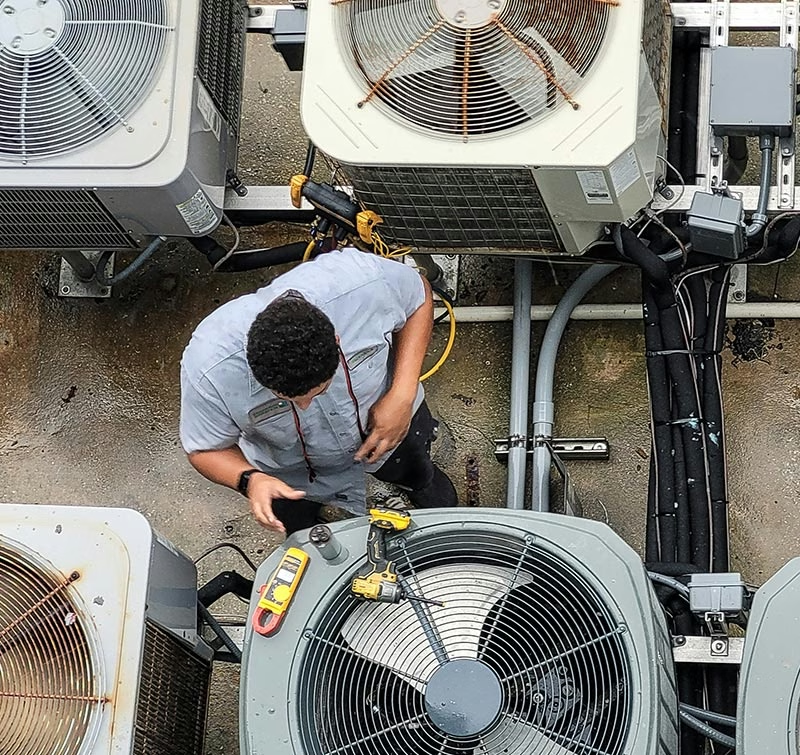
Condenser fins sit close together, and dirt loads from the outside face inward. Spraying that outside face with a garden hose drives the debris deeper into the coil, so the cabinet looks better and performs worse. Doing it right means applying a coil detergent that breaks down the oily film holding pollen and dust to the aluminum, giving it time to work, then rinsing from the inside of the coil outward so everything leaves through the same face it came in through. That is a different job from a rinse, and it usually means pulling the top and getting hands inside the unit.
The reason it matters shows up in August. A condenser has to reject heat into whatever air is available, and here that air is over 100 degrees by mid afternoon. Restrict the airflow through that coil and condensing temperature climbs, head pressure climbs with it, and the compressor is now working harder to move less heat. Capacity drops right at the hour you need it, run times stretch until the system never satisfies, and amp draw rises. Compressors and capacitors do not fail at random in this climate. They fail after seasons of running against a dirty coil.
One Homeowner Who Had Been Getting the Shallow Version
Sandra Smith had been having her air conditioner maintained before she called us, so on paper she was doing everything right. What she had not gotten was the part of the visit that changes how the system runs. Her outdoor unit had never been washed with a detergent, and nobody had cleaned the fins from the inside out. Her review says it plainly: previous maintenance did not do either. That is the most common gap I see in this city, and a homeowner has almost no way to spot it, because a coil rinsed from the outside looks fine from three feet away.
Javier ran ahead of schedule that day and called her first to make sure an early arrival worked for her, which is how it should go. He then did the outdoor unit properly. In Sandra’s words, she was “Impressed he used a detergent and cleaned the fins properly from the inside out.” With the coil actually clean, the conversation that follows becomes useful instead of generic, and he walked her through what he found on her unit along with filters, surge protection, and other efficiency and safety recommendations she could weigh on her own timeline.
She came away recommending both Javier and our company, and the detail she called out was continuity: the same technician is assigned to her home each visit. That is deliberate. A technician who saw your coil last spring knows what normal looks like on your equipment and notices drift a stranger would miss, which is a large part of why our HVAC maintenance plans assign members a consistent tech instead of whoever is closest.
How to Tell a Real Tune-Up From a Filter Swap
Watch for four things. Water and detergent should come out, and the technician should be inside the outdoor cabinet, not circling it. Meters and gauges should come out, because you cannot judge charge or a capacitor by feel. You should get numbers, in writing, that you could hand to another contractor. And any recommendation should arrive with the reading behind it. A visit that lasts twenty minutes, uses no water, produces no measurements, and ends with a quote for a new system is not maintenance. Our team has been a family owned company here for over 15 years, and the fastest way to lose a customer in this town is to charge for a tune-up you did not perform.
One Thing to Do Before You Book
Walk out to your outdoor unit this week and look at three things: whether shrubs or a fence are inside about two feet of clearance on all sides, whether a sprinkler head is spraying the cabinet and baking mineral deposits onto the fins, and whether the pad has tipped enough that the unit is visibly out of level. Those are the problems that quietly undo good maintenance between visits, and all three are cheap to fix now. Once you have looked, schedule your AC tune-up for the next open spring date and let a technician handle the parts that need gauges, a meter, and detergent.
Frequently Asked Questions
How often does an air conditioner in San Antonio need a tune-up?
Once a year for cooling, ideally in late winter or early spring. Heat pumps carry the load in both seasons here, so those systems do better with a second visit before winter.
Is a tune-up still worth booking in June or July?
Yes. A coil cleaned in July still lowers head pressure for the rest of the season, and finding a failing capacitor in a driveway is far better than finding it during a Saturday outage.
How long should a thorough tune-up take?
Plan on an hour or more for a single system. Cleaning a condenser coil correctly and taking real readings simply cannot be done in fifteen minutes.
Can I clean the condenser coil myself?
You can gently rinse the outside and keep vegetation cleared, which helps. Detergent cleaning from the inside out, plus anything involving refrigerant or electrical components, belongs with a licensed technician.
Does a maintenance plan make sense for an older home?
Often yes, because older systems and older ductwork drift more between seasons. The bigger benefit is having the same technician who already knows your equipment tracking those changes over time. Smart Choice Heating & Cooling services Kirby, TX and the greater San Antonio area.
Sources and References
About the Author
Alonzo Martinez is the owner of Smart Choice Heating and Cooling, a family owned company that has served San Antonio and more than 25 surrounding communities for over 15 years under Texas license TACLB 103516E. He leads a NATE certified team that handles refrigerant work under EPA Section 608 standards and holds a 4.9 star rating across 202 Google reviews. He built the company on upfront pricing, honest findings, and no unnecessary upsells.